
The quick answer
A Greenville rental owner should be able to open one monthly report and understand the property’s financial position, current operating issues, protection status, lease timing, and next required action. If the owner must search a portal, reconcile transactions, and send several follow-up messages to understand the month, the reporting has not done its job.
HLR’s standard is simple: owners should have visibility without inheriting the workload. Communication still happens during the month when an issue requires it. The monthly report brings the complete picture together—even when the correct conclusion is “no owner action needed.”
Seven answers a useful monthly report should provide
- Was rent received?The report should make collection activity and any exception visible without forcing the owner to reconstruct the ledger.
- What was paid to the owner?Owner proceeds and the path from rent received to disbursement should be understandable.
- What fees or expenses were charged?Management fees, protection charges, repairs, vendor expenses, and other deductions should be identified clearly enough to review.
- Is maintenance open?The owner should see whether there is an active request, what has happened, who is responsible now, and whether approval is needed.
- Is protection or insurance status current?The report should show the relevant known status so a compliance or coverage issue does not quietly disappear.
- What is happening with the lease?Key lease timing, renewal activity, or an approaching move-out should be visible before it becomes urgent.
- Do I need to act?The report should end ambiguity with a clear request, owner decision, or confirmation that no action is currently needed.
See the standard instead of taking our word for it
HLR publishes a redacted example of an actual owner report because “great communication” is too easy to claim. The sample shows the categories an owner can review: rent activity, owner proceeds, management fees, protection status, maintenance, lease information, year-to-date performance, and the owner’s next step.
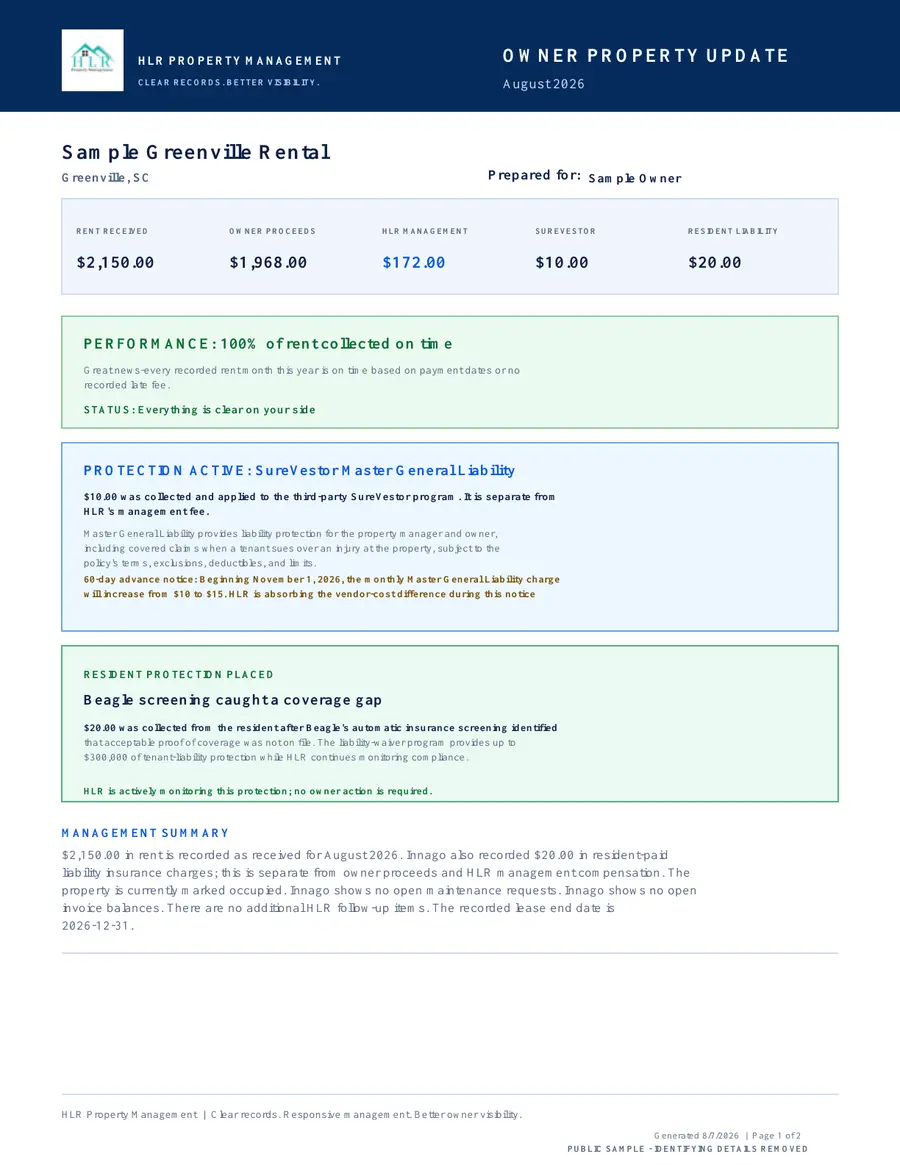
Open the full redacted monthly owner report
The sample is historical and illustrative. Current pricing, services, protection terms, and executed agreements control.
See what each report section demonstrates →An owner portal is useful—but it is not the report
A portal is where owners can access supported statements, transactions, documents, and property information. It is valuable infrastructure, but it does not automatically explain what matters.
The monthly report should sit above the portal data and answer the operating questions: What changed? Is something off track? Who is working on it? What happens next? Does the owner need to decide anything?
This is especially important for owners with one to ten rental homes. They usually do not need enterprise-level dashboards. They need a reliable answer without another system to manage.
Warning signs that the owner is managing the manager
- You have to ask whether rent arrived after the normal payment cycle.
- You see a repair charge but cannot tell what was resolved.
- An open maintenance issue has no named next step.
- You do not know whether the resident’s required protection or insurance information is current.
- A renewal or move-out date becomes urgent before it becomes visible.
- The only update is a portal notification or transaction list.
- You regularly send “just checking in” messages to learn the property’s status.
No property manager can promise that every month will be uneventful. The standard should be that issues remain visible, responsibility is clear, and the owner does not have to chase routine answers.
Use this five-minute evaluation
- Open your most recent owner statement or report.
- Identify the rent collected, owner proceeds, fees, and other deductions.
- Find every open maintenance or resident issue and its next responsible party.
- Confirm the lease timing and relevant protection status.
- Answer one final question: Do I know whether I need to do anything?
If those answers are not clear, ask the property manager to show you the reporting process before switching systems or adding more software. The gap is often not access to data; it is the lack of a consistent summary and accountable follow-through.
Frequently asked questions
What should be in a monthly property management report?
A useful report should show rent activity, owner proceeds, management and other charges, open maintenance, lease timing, protection or insurance status, decisions needed from the owner, and the next responsible party.
Is an owner portal the same as a monthly report?
No. A portal stores transactions and documents. A monthly report should interpret the important activity, identify exceptions, and tell the owner whether any action is required.
Should an owner receive a report when nothing went wrong?
Yes. A quiet month still deserves confirmation that rent and disbursement activity were processed, no unresolved issue requires attention, protection status is known, and the owner has no current action item.
How often should a property manager communicate?
Event-driven issues should be communicated when they require attention. A consistent monthly summary then closes the loop by showing the property’s financial and operating status in one place.